
The Teacher vs Students Game: A great tool for behavior management

We all know that in the learning process we engage in certain behaviors because those behaviors have been reinforced.  Something nice has occurred when we have behaved in a certain way.  Other behaviors are not engaged in because those behaviors have been punished – something unpleasant has occurred, or quite often nothing has happened at all.  By considering which behaviors lead to pleasant consequences and which behaviors lead to unpleasant or neutral consequences, every human is constantly learning.

Recently there have been those who have attempted to advance the idea that teachers shouldn’t use methods of reinforcement or punishment to manipulate student behavior.  This opinion indicates an inadequate understanding of the principles of behavior.  Every interaction that we have involves reinforcement or punishment, whether the process is overt enough for us to be aware of or not.

Advantages of positive reinforcement

Reinforcement has several advantages over punishment/nagging:

  • Reinforcement can be used to teach a new skill and to encourage its use. Punishment procedures teach students what behaviors to avoid, not what to do.
  • Reinforcement procedures can teach the student to behave even when the teacher is not in the room because at some point the new behavior acquires its own reinforcing qualities. Punishment only works if the teacher is around to enforce the consequences.
  • Reinforcement used effectively makes long lasting changes in student behavior. Punishment doesn’t.
  • Reinforcement procedures bring about positive feelings. Punishment procedures will never lead to positive feelings.

At least three positives for every correction

Teacher standing in front of class teaching finding factors.It has been clear for a long time that at a minimum of a 3:1 positive to negative interaction ratio is necessary for long term success in the classroom.  Teachers must overtly recognize appropriate behaviors at least three times more frequently than they recognize or attend to behaviors they don’t want.   If teachers’ interactions with their students are less frequently positive than 3 to 1 then students will not be focused on appropriate behavior.   Less frequently positive than that and students will not think they are being good and therefore won’t be motivated to continue being good.  Less frequently positive than that and teachers will be primarily attending to, and thereby reinforcing, inappropriate behavior.

Benefits of the Teacher vs Student Game

It has also been clear for a long time that one of the best ways to be certain that the ratio is in place is by use of the Teacher/Student Game, AKA the Teacher/Kid game, the Me/You game.  While this “game” has been around for a long time, its fundamental usefulness as a student motivation and management tool is often overlooked.  This game has several important benefits, especially for teachers who need to improve the effort, motivation, and behavior of their students.

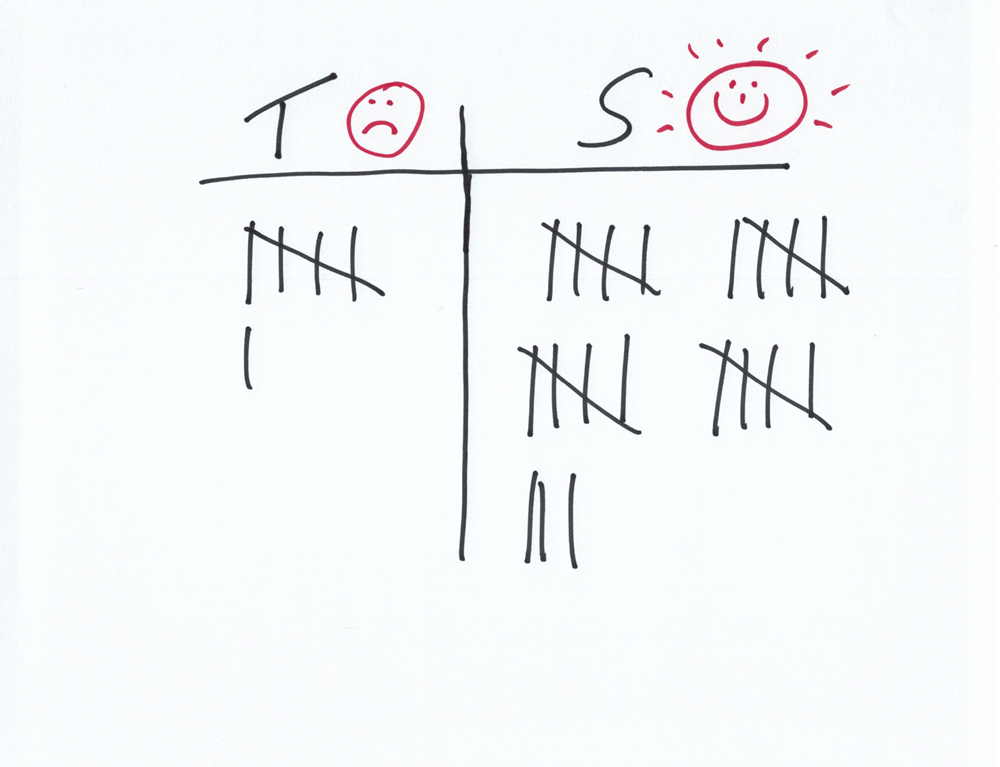
  1. The Teacher/Student Game allows the teacher to have a visual record of the amount of reinforcement and recognition being given—so the teacher can see when he/she needs to increase it.
  2. The game allows the teacher to provide an immediate consequence for inappropriate behavior, but a very mild consequence, and one that can be delivered in a friendly-upbeat kind of way.
  3. This procedure allows the teacher to provide social reinforcement for specific behaviors—but provide it to the group, thereby improving group solidarity.
  4. Playing this allows the teacher to keep track of the ongoing ratio of interactions during the lesson.  If the teacher sees that interactions regarding inappropriate behaviors are increasing—he/she will have to diligently increase the frequency of “catching them being good.”
  5. Because of the social nature of the game, it is not always necessary to “pay off” with tangible reinforcers.
Setting up the Teacher vs Student Game

So how does one set up this amazing behavior-monitoring-and-improving game? To set up the game prior to class starting, the adult draws a “score board” somewhere (anywhere!  paper, white board, blackboard, etc.).  See the example above.  The scoreboard must be both visible to the students and easily accessible so the teacher can award points to the class or him/herself as frequently as needed.

At the very beginning of the lesson, during the lesson introduction, the teacher tells the students that they will be playing the Teacher/Student Game and goes over the expectations as part of explaining how the game will work.  At the beginning of the school year, this is the time when the rules/expectations for the particular setting (small group instruction, whole class instruction, etc.) are taught to mastery.  As the year goes on, the expectations for the setting are mentioned as a “reminder.”  The initial set-up with the kids could go something like this:

“We’re going to play a game, me against you.  I think I can win because I’m really smart and I win this game A LOT!  Here is how it works:  You get points for getting things right, and for following the rules which are (Replace with your expectations here.) everyone answering the first time on signal, everyone keeping their eyes on the lesson, and everyone waiting their turn to talk.  But I get points whenever someone forgets the rules or makes a mistake.  I bet I’m going to win.  I’m really good at this game!”

Begin immediately awarding points for good behavior

Right away, as you are naming your expectations, the children will straighten up and pay careful attention.  Immediately give their team a point, dispiritedly, saying something like:

“Oh Gosh!  You guys have your eyes on me so well I have to give you a point.  You’re already ahead!  But I know you’re going to forget the rules and then I’ll win!”

Of course, the children immediately begin enjoying their lead in the game and begin feeling proud of their accomplishment.  And if you are disappointed and ham it up a bit—the children begin to have fun, while they try even harder to beat you.

As soon as the lesson starts, give the students points for meeting all of your expectations—before they have a chance to forget.  Give them points for answering correctly, keeping their eyes on the lesson, etc. and tell them what it is that they did to earn the points.

“Oh my!  I’m going to have to give you another point because everyone waited to be called on.  Darn!  You’re ahead, but I’m going to catch up soon!”

Gleefully give yourself points for every off-task behavior

Give yourself a point energetically, obnoxiously and gleefully whenever, even one child, needs a question repeated, doesn’t have his/her eyes on the book, interrupts you, talks to a neighbor, etc.  When you give yourself the point (Keep the score board VERY public!) tell the group:

“Yea!  I get a point because someone talked out [or whatever the misdeed is].  I knew I was going to win!”

Be obnoxiously cheerful about getting a point.  Make sure that you are so annoying that they really want to beat you!  If you do this right, they will hate letting you have even one point and so will be motivated to monitor their own behavior closely and follow the rules carefully.

Many teachers who are reluctant to give themselves points, end up ignoring minor misbehaviors.  Some teachers may be afraid to discourage the children or want the children to have more points and be enthused.   However, this is exactly the wrong way to play the game.  Instead, the teacher should catch EVERY infraction and take EVERY point possible.  This will enforce high standards and make the children adhere to excellent behavior.

Be vigilant to “catch ‘em being good!”

Remind yourself that you want to increase the positive behaviors, so you have to notice them and give points for them.  Catch, comment on, and give points for students being good at least three times as often as you have to give yourself a point.  Focus hard to catch students answering correctly, demonstrating attending behavior, tracking in their books, looking at the Teacher Presentation Book, answering on signal, etc.  Comments must be brief, exciting, and clearly identify both the behavior and the student.

The rule is to keep the ratio of positives up—at least 3 times more responses to good behavior than infractions you catch.  Catch every infraction, but then catch three times more instances of students doing the right thing.  The less mature the group, the more frequently you are going to have to reinforce correct behavior—until they get into the groove.  A teacher working to bring a primary age group under control might need to find 50 or 60 instances of students doing the right thing, and give them positive comments in a 30 minute period.  This is hard work, but it pays off, because student behavior will improve to the point that lessons will go smoothly.

Remember, you must “ham it up” and act discouraged when you give the group points and they continue to beat you.  You’re always going to lose the game—but you will be winning in your classroom.


Tool skills: foundational academic skills

What are the foundational academic skills or tool skills?

The foundational academic skills are 1) fluent reading or decoding (being able to read the words on the page easily), 2) fluency with math facts (instantly answer single digit facts like 9+6 or 7×8), and 3) spelling correctly and easily.  Educational researchers call them “tool skills” because they are the tools students need to do academic work successfully. These skills need to be developed to the point of fluency, where students can do them accurately, quickly and easily.

Why are foundational academic skills important?

These tool skills are critical because they form the foundation of academic work.  Students who struggle to figure out the words on the page or who make a lot of errors, do not have much attention left to think about the message of the passage.  Students who read correctly and fluently, can think about and benefit more from what they read.  In elementary school students transition from “learning to read” in the primary grades, to “reading to learn” beginning in about fourth grade. By the end of third grade students should be able read fluently and easily.  It can be measured by having students read aloud for a minute.  They should be able to read 125 to 150 words per minute with very few errors.  Conversely if students are still struggling with learning to decode in the later grades, (a) they will not get much help to improve that, and (b) they will not learn from or benefit from what they are assigned to read, and (c) they will not read for enjoyment.  They are unlikely to ever be successful or enjoy school.

Students who can answer math facts instantly, without hesitation, are able to learn computation and higher math skills with relative ease.  Those who are still counting on their fingers to do math facts in the upper elementary grades start falling behind in math.  They come to hate it, because it is so onerous.  Students who have not memorized the math facts do not succeed in high school math.

Students who struggle to spell, also become averse to writing.  They avoid it and do not write well, as the struggle to remember how to spell words gets in the way of expressing themselves.  Conversely, those who can spell easily find it far easier to express themselves in writing.

Are foundational academic skills an issue in many schools?

Yes.  Back before the 1960s, these tool skills were the major focus[1] of the elementary years.  Over the past few decades, unfortunately, most American schools of education have denigrated the importance of these tool skills.  Worse yet, teacher preparation courses include almost no training for teachers to learn how to help their students develop tool skills.  While some students develop proficiency in these skills without help from their teachers, the rest of the students need the teacher and the school to provide some focus and attention to fully develop these foundational skills.

What Parents should look for to evaluate foundational academic skills

It’s very easy for a school to proclaim that they care about foundational academic skills, (AKA tool skills) but don’t take their word for it.  You really need to see evidence of it.  Interestingly, the effort needed to teach these skills and to motivate students to build these skills requires that the school do things like post records and keep track of students’ success publicly.  If an elementary school wants all its students to be able to readily read, they are going to have to have students read aloud and correct their errors.  They are going to have to frequently measure students with timed readings and keep track of how they are doing.  Parents need to look for the activity of reading aloud during reading class.

If the school wants students to acquire fluency in math facts, they are going to have to recognize students as they develop this skill—and you’ll see it on classroom walls somewhere.  The same with spelling.  If it is a priority, then you’ll see evidence of that on papers posted on the wall, or even spelling tests posted.  You may also see words that are being learned posted on the wall.

Conversely, in schools where these foundational academic skills are not emphasized, you won’t see evidence of students striving to excel in these areas.  If you see student papers posted, you’ll find uncorrected spelling errors and arithmetic errors.  In a classroom where decoding is not emphasized, you may not hear any students reading aloud.  When you do hear students reading, you’ll hear many errors made that are not all corrected by the teacher.   If you visit an elementary classroom during reading and you do not hear students reading aloud and being corrected, you know that accurate decoding is not being developed.  Don’t expect that school to teach your child to read.

How teachers can support foundational academic skills

It is quite hard for a teacher to support foundational academic skills in the absence of school-wide support for these skills.  Most notably in reading decoding, it takes a school-wide structure and placement to get all students at the correct instructional level.

To develop decoding skills, students must be carefully grouped and instructed at their instructional level, where they can read 98% of the words in the material without help. That’s less than 1 error per sentence. To group students that precisely for reading instruction requires a school-wide effort and sharing students between classrooms.  If a student is asked to read material in which he or she does not know several or even a couple of words in each sentence, the students will not be able to learn all those new words and will become discouraged.  This is what happens in schools when the teacher is left on his or her own to do instructional grouping.

If students can be grouped at their instructional level in reading, you as the teacher must then learn to correct all errors in word reading.  The procedure is to interrupt the student, tell them the correct pronunciation of the word, have the student repeat it, and then go back to the beginning of the sentence and re-read it.  We want the student to learn to read the word correctly the second time through. Every time, with every word they don’t know. If you try to spare your student’s feelings, by glossing over errors they make when reading, they will have no opportunity to learn the words they don’t know.  [The importance of proper instructional grouping becomes obvious if you are to correct all errors.] To be most effective you should keep track of error words and put them on the board and give students extra practice on reading those words in isolation.  Practice in reading words in isolation (learning them) as well as reading aloud every day is essential.

Timed readings are essential to measure the growth of fluency in the early years of reading instruction.  As students learn more and more words, they can read with greater fluency.  Doing timed readings frequently tells you whether or not the student is progressing by being able to read more fluently and easily.  You have to keep track of their correct words read per minute.  Students who are not progressing need to be given extra time to read aloud with a partner who corrects all their errors.  By fourth grade, students should be reading between 125 and 150 correct words per minute.  Once they reach that level of fluency, they don’t need as much focus on timed readings.  Students who are below 100 words per minute need intervention to develop their fluency, by daily practice reading aloud at their instructional level.

When it comes to developing math fact fluency, this takes time every day throughout the elementary years.  Once a teacher starts trying to build this skill, they realize that they have to keep track of what facts the students know and what facts they still have to figure out.  Teachers need a systematic presentation of what students need to learn as well as some review of what they’ve already learned.  A teacher needs a systematic instructional program to keep this in order, such as Rocket Math.   There needs to be at least 10 or 15 minutes a day devoted to math facts fluency development each day—but not much more than that.  Students need to be encouraged to do the work to become fluent in math facts, so the teacher will need some way of motivating students by recognizing progress and celebrating it.

Spelling is also not supported in many schools and a teacher would need to find a spelling program to use to build the skill in the absence of a school-wide spelling curriculum.  Learning words for a weekly spelling test is not a particularly effective way of developing spelling, but it is better than nothing.  Writing words multiple times in a row is not effective for learning either.   A better spelling curriculum is one that requires students to spell from the teacher’s dictation and do it on a daily basis.  Also, dictating sentences and requiring them to be spelled correctly is a very good exercise as long as it is at the students’ instructional level of about 98% correct from the beginning. See Rocket Spelling.  So again, the importance of careful instructional grouping becomes apparent.

It is important for teachers to know that spelling for the sake of spelling, as in a test, is far easier than spelling correctly while composing and writing a composition.  Therefore, assigning a spelling test of words that students misspelling in their written work is not helpful.  The error was usually only a result of not paying attention, and is easily corrected when the error is pointed out to the student.  However, requiring students to re-do and correct any spelling errors in their written work is still very important.

How a school can support foundational academic skills

The most important curricular decision a school or district can make is the choice of a program for developing reading skills.  The reading program they choose must provide systematic and explicit phonics to help students learn to break the code and learn to read.  It must be decodable, meaning the material students are asked to read consists of words they have already had an opportunity to learn in earlier lessons.  The program must include, at least for the first three grades, timed readings to ensure that students are developing adequate fluency.  Some students need quite a bit more practice to develop reading skill, and therefore you have to measure their skill to see who needs extra work.

The reading program must have careful placement tests so students can be placed at their instructional level.  This implies that some students will have to “walk” for reading (move to a different classroom where their level is being taught), so that all students can be placed at their instructional level. The program must require students to read aloud daily and to read accurately as well as be timed to see that they are developing fluency.

It is extremely rare for an eclectic or teacher-developed reading program to have these essential features.  In fact, most commercial reading programs do not have these features.  However, a program that does have these features can teach all students to read and succeed each year in developing reading skill.  The school should be measuring the development of decoding fluency systematically.  Then it will be clear whether or not the reading program is effectively developing fluency in reading.

Beyond choosing an effective reading program, the school administration must monitor the implementation as well as the student data on mastery of the material and the development of reading fluency.  There must be clear guidelines on what to do to remediate students who are not improving in reading.  There must be plan in place to provide extra reading practice for students who are not developing fluency at the expected rate.

An important truism about education is that the sooner you provide remediation and extra help the easier it is for the student to catch up.  If you work with a student, who did not learn something from today’s lesson, later the same day, you can catch them up in five minutes.   If you wait a week, it will take an hour to catch them up.  If you wait a couple of months, it will take many days of work to get that student caught up.  Therefore, the most important thrust of a school is to test frequently and begin remediation quickly.   This should be the most important mission of the instructional leaders—to help teachers readily identify and quickly remediate any student who is not fully mastering the material.

To develop math fact fluency in all its students, an elementary school must have a math fact program.  It is rarely sufficient to have a “math facts component” in the adopted math curriculum.  Math fact fluency must stand by itself to be sure it is addressed daily.  Then the teachers need to make it a priority to set aside time for focusing on it.   Math facts have to be in the daily schedule and it cannot be skipped over.  There need to be school-wide expectations on what the curriculum being used expects teachers to do.

Administrators should visit classrooms to be sure teachers are following the expectations of how fact fluency is to be developed according to the curriculum being used.  Teachers must be expected to keep track of student progress and to test students to see if they are learning as they should.  If the program does not develop noticeable improvement in math fact fluency, then it needs to be modified or replaced.  Every student can develop fluency with math facts and it is malpractice to allow students to reach the upper elementary without knowing their facts.

For a school to effectively support spelling proficiency, there must be a spelling curriculum that is shared across the school.  The school leaders must insure that all students are successful in the spelling curriculum, and that remediation is provided ASAP for any students who are not doing well. This means that if some students are far behind expectations for what they are able to spell, they may need to “walk” to a lower grade classroom to receive instruction at their level.

The second component in developing spelling skill is to hold students accountable for spelling correctly in all their written assignments.  It begins by not allowing any papers with  spelling errors to be posted on the board.  All errors must be corrected before recognition.

There will be two types of spelling errors. One type will be words that have not yet been taught in the spelling program.  Those should be corrected and the work re-copied to practice spelling the word correctly. The second type will be words that have already been taught in the spelling curriculum.  Making errors on those words is not good and should have some kind of consequence on top of re-copying the assignment, such as writing the word ten times.

Remember, a focus on spelling in the elementary years means that students will learn to automatically spell words the right way, and it will enable them to express themselves more easily and fluently in life.  The more words students know and spell automatically the more students can concentrate on their composition and the expression of ideas.


[1] More time was spent on the foundational academic skills than any thing else during the elementary years.  All teachers knew these were the most important skills.  They were measured and teachers knew that for students to succeed they needed to be good at these skills.  It went on everyone’s report card.  There were plans to help students succeed if they were struggling, sometimes even having students repeat a grade if they were not doing well with these foundational academic skills.

Kindergarten Learning Track: (LT 0.1) Counting and Subitizing

Kindergarten Students have things to learn before memorizing Addition Facts

There are two Learning Tracks in the Rocket Math Online Tutor that can help kindergarteners get ready for memorizing Addition Facts in the first grade.  Before doing addition students have to be able to count items and match the name of the number with its representation–that’s Counting and Subitizing.  The other skills they need to develop are the understanding of addition as adding two groups of objects along with the skill of “counting on” from a number other than one–that’s Conceptual Addition.

Counting and Subitizing is the first Kindergarten Learning Track.

Counting and Subitizing begins by teaching students what number of objects they are seeing and showing them where to tap that number on the keyboard. The first time each screen is introduced (and whenever there is a hesitation or an error), the Online Tutor tell the student the answer. Here’s what the Online Tutor says for this screen.  “This shows 4 cars. Tap the 4.” You can see that the number 4 is outlined on the keyboard so students learn which numeral is 4.

Each numeral from zero to 12 is taught on many screens.  Each numeral is represented by several different kinds of objects including cars, trees, ducks, chickens, pennies, pencils, hashmarks, dice and fingers.

Corrections in the Online Tutor are very robust.

The Online Tutor tells and shows the answer, then tells the student, “Your turn.”  The student is shown the correct number to tap the first time, and then is shown the picture without the correct number being outlined to answer a second time.  Then a different problem is shown and the student has to answer that.  Then the Online Tutor goes back to the item missed and asks the student again.  After interspersing with another screen the missed item is tested a third time.

Online Tutor Teaches the concept of zero.

Uniquely, the Counting and Subitizing Learning Track also teaches the concept of zero.  Here’s what the Online Tutor tells students for the picture to the left, “This shows no fingers, zero fingers. Tap the zero.” While saying that, the Online Tutor also shows students where the zero is on the keyboard.


Subitizing skills are built into the Online Tutor

The Counting and Subitizing Learning Track shows items in groups of three, four and five items to help with the subitizing skill. By seeing these examples again and again students will come to know that two groups of five are ten, or a group of three and a group of four are seven, and so on.  Each set of items is taught first to students, for example: “This shows twelve pencils.  Tap the 1 and then the 2.

New Learning Track: (LT 1.0) Conceptual Addition

Students have things to learn before memorizing Addition Facts

There are two Learning Tracks in the Rocket Math Online Tutor that can help students get ready for memorizing Addition Facts in the first grade.  Before doing addition students have to be able to count items and match the name of the number with its representation–that’s Counting and Subitizing.  The other skills they need to develop are the understanding of addition as adding two groups of objects along with the skill of “counting on” from a number other than one–that’s this one: Conceptual Addition.


We begin with adding two groups of objects

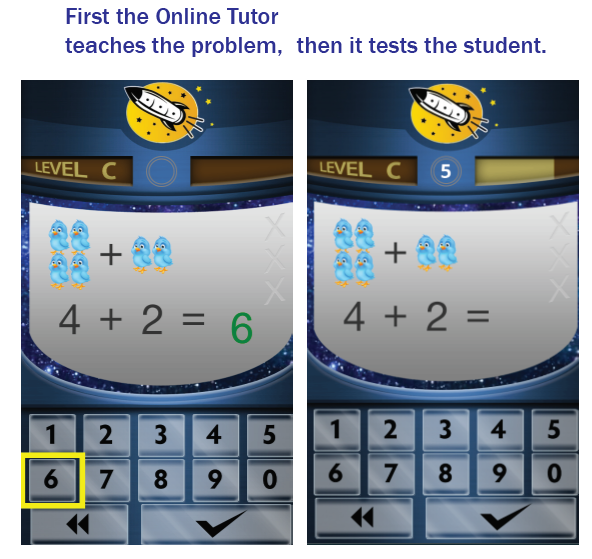
Children who understand the concept of addition know that it is counting all the items in two groups of objects.  Learning Track (1.0) Conceptual Addition begins with having the students provide the answer to simple addition problems with the objects displayed.  Each problem is first taught by the Online Tutor.  It shows a screen like this and says, “This shows 4 birds plus 2 birds equals 6 birds. Tap 6.”  Then it presents the problem without the answer showing for the student to practice.  If the student cannot answer in 3 seconds or answers incorrect, the Online Tutor teaches the problem again and then tests the student immediately.


“Counting on” from a number is the next skill

Student need to learn to “count on” from a number other than one in order to be able to add problems with sums above ten. (Without “counting on” you can’t add five and six on your fingers!)  The Conceptual Addition learning track teaches the skill of “counting on”  from early on in the sequence.  The teaching and correcting narration includes the counting on for each problem.  As illustrated in the example here, the Online Tutor teaches, “Start with four and count 3 more.  Four, five, six, seven.  Four plus three equals seven.  Tap seven.”  This instruction is presented the first time the student sees the screen and every time the student hesitates or makes an incorrect response. So the Online Tutor models “counting on” with every problem presented in the rest of the learning track.


Adding zero is taught as well

Students need to understand what to do when they encounter working with zero.  So there are some problems that include adding zero in the learning track. The concept of zero is taught in the Counting and Subitizing learning track.  Here students are taught that you “count zero more.”  Here is the teaching and correcting script for adding zero that goes with the screens on the right.  “Start with 4 and count zero more. Four. 4 plus 0 equals 4. Tap 4.”  This problem and another with adding zero continue to be reviewed throughout the learning track.


Problems go up to 9 plus 9.

Students encounter all of the basic facts up to 9 plus 9.  They learn that the procedure of starting with the larger number and “counting on” the number of times of the other number will lead to the right result.  We want them to understand the concept of addition.  They will understand the concept well before they finish the learning track.

Fraction & Decimal Equivalents Learning Track

List of Learning Tracks Continue to purchase

Fractional & Decimal Equivalents

This learning track gives students practice in identifying four kinds of equivalents.  All the equivalents practiced in this learning track are listed in the sequence shown at the top of the page.  In the virtual filing cabinet you can also print out the sequence. Note that this is Learning Track 16 in the Online Tutor.

Decimals that are equivalent to common fractions

The first type of equivalents students learn are decimal numbers to a fraction.  An example is 0.667 is equivalent to the fraction 2/3.  Decimals such as 0.4 = 2/5 or 0.25 = 1/4 or 0.125 = 1/8 are practiced.  Twenty-five of these equivalents are learned.  These are the most important items and are the equivalents that get the most practice.

Fractions in decimal form (tenths and hundredths)

A second kind of equivalent is that of a fraction in decimal form, such as 66.7/100 (which is equivalent to the fraction 2/3).  Another example is 4/10 which is equivalent to 2/5.

Fractions equivalent to division problems and vice versa

The other two kinds of equivalents show the interchangeability of division problems and fractions.  The fraction 2/3 is equivalent to dividing 3 into 2.  Conversely, dividing 3 into 2 is equivalent to the fraction 2/3.   These are introduced, but because they follow a rule, these are not tested as thoroughly as the decimals equivalent to fractions.


Rounding up to Millions Learning Track

List of Learning Tracks Continue to purchase

Rounding up to Millions

This learning track gives students practice in rounding to the nearest ten thousand, nearest hundred thousand and nearest million.  Students practice with numbers with varying numbers of digits, starting with 3-digit numbers and going up to 5-digit numbers.  The sequence of the kinds of numbers students learn to round is shown above.

Each worksheet includes four examples of rounding.

We give four examples of rounding at the top of each worksheet so that students can see how to round each type of number.  Then students work with their partner, who has the answer key, to round the numbers around the outside. The student says the “answer” which is the rounded number.  The partner corrects errors by saying the number and what it rounds to aloud, (e.g., “8,621 rounds up to 9,000”) and follows the same correction procedure: Ask the student to repeat the correct information three times, then back up three problems.

1-minute Daily test requires writing only 3 numbers

The Daily Tests do not require the student to write out the complete number.  Instead, they only have to write three digits of the rounded number.  This allow students to answer more questions in the one-minute test.


Rounding up to Thousands Learning Track

List of Learning Tracks Continue to purchase

Rounding up to Thousands

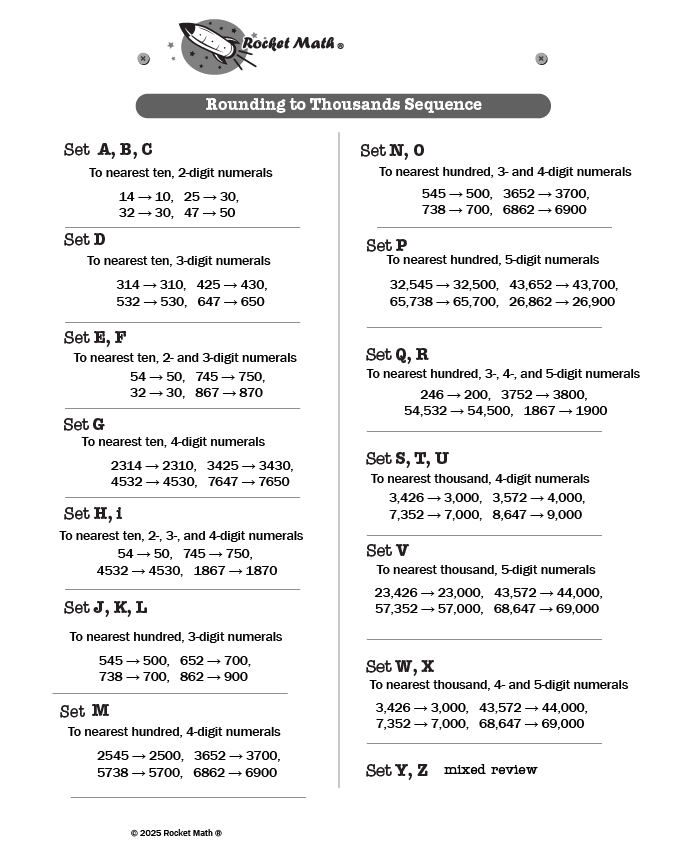
This learning track gives students practice in rounding to the nearest ten, nearest hundred and nearest thousand.  Students practice with numbers with varying numbers of digits, starting with 3-digit numbers and going up to 5-digit numbers.  The sequence of the kinds of numbers students learn to round is shown above.

Each worksheet includes four examples of rounding.

We give examples on each worksheet so that students can see how to round each type of number.  Then students work with their partner, who has the answer key, to round the numbers around the outside. The student says the “answer” which is the rounded number.  The partner corrects errors by saying the number and what it rounds to aloud, (e.g., “8,621 rounds up to 9,000”) and follows the same correction procedure: Ask the student to repeat the correct information three times, then back up three problems.

1-minute Daily test requires writing only 3 numbers

The Daily Tests do not require the student to write out the complete number.  Instead, they only have to write three digits of the rounded number.  This allow students to answer more questions in the one-minute test.


Educational apps should answer these six questions for the teacher

Educational apps should provide information on whether students are progressing and whether they are learning.  Teachers want to know how their students are doing and if they are benefitting.  Teachers need to know if students are engaging and if they find it too difficult.  Here are six key questions that all educational apps should answer for teachers.  Examples of how these answers would look come from the Rocket Math Online Tutor (RMOT).  This educational app answers these six key question in real time on the website and for download into spreadsheets.

(1) Are students engaging with the app?

Students only learn when they engage with an educational app.  Teachers need information on how many of their students are using the app and how frequently.  The RMOT has a page called “Review Progress” where this information is available.  The first info centers on engagement with a chart showing what percentage of the students are completing how many sessions over the last 14 days.  Students are rated “good” if they complete 12 sessions in 14 days.  That translates in the last two weeks to a ten-minute session every day at school and a four times additionally as homework.  That rates as “3 stars” or a grade of “B.”  In the example above, 65% of the students in the class have completed that number of sessions or more.  Also, 88% of the students are working at a steady pace, of 8 sessions over two weeks.  So 88% of the students are engaged enough to see benefits.

(2) Who’s been making progress?

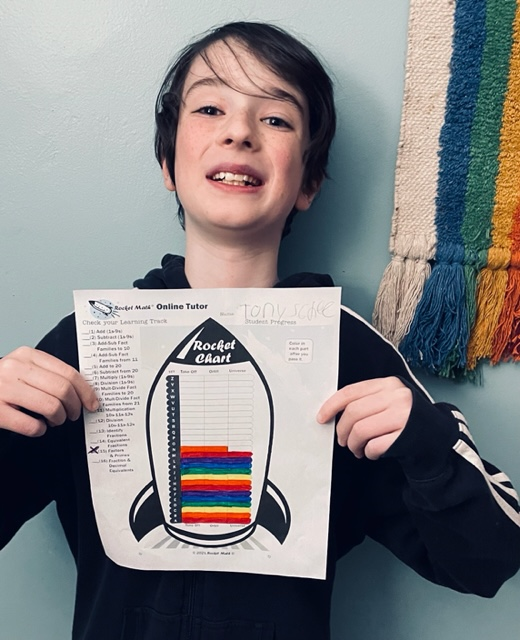
Educational apps should keep teachers aware of which students are working and making progress.  RMOT teachers can enable a Daily Progress Report to be sent to their email.  This shows for each individual student how many sessions they started and how many they completed the previous day.  If students complete one ten-minute session at school, the teacher can see if any students completed an additional session at home. The Daily Progress Report also tells the teacher which students are making progress.  Student progress shows when they pass one of the 26 A to Z levels in each learning track, such as Addition, Multiplication, or Fractions.  Students can then celebrate their progress by coloring in that level on their Rocket Chart.

(3) How far have the students progressed?

Educational apps should show the teacher how far students have progressed in their learning objectives.  RMOT makes progress clear to both students and teachers because each learning track is broken into 26 A to Z levels.  As students pass levels on the way to Z, the app congratulates them and makes their progress obvious.  In addition, the Review Progress page graphically displays how far students have progressed in each learning track.  And of course, the students are encouraged to keep track of their progress on their individual Rocket Charts.  These Rocket Charts are so important to the students, it’s where the app came to be named “Rocket Math.”

(4) Is there evidence of student learning?

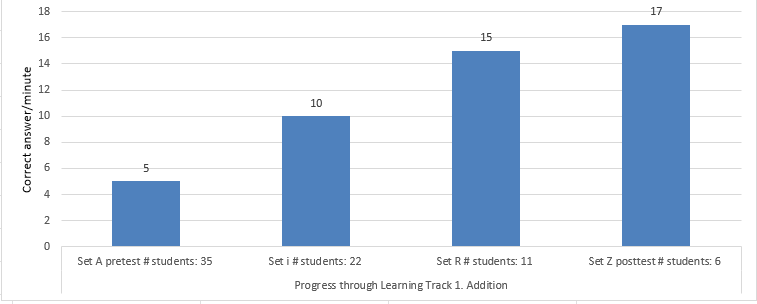
An educational app like RMOT should show evidence of student learning, not just completing exercises.  RMOT measures math fact fluency through giving students 1-minute races, or fluency tests, periodically as they work through learning tracks and whenever these are assigned by the teacher.  This data is collected and is always available to export as an excel file.  Above is an example of a class of 35 students who began the Addition learning track with an average fluency of only 5 correct problems per minute.  The students who have completed the learning track have an average fluency of 17 problems per minute.  This data is also shown in chart form on the top of the Review Progress page.

Teachers can also assign fluency tests periodically.  The RMOT Review Progress page also shows the scores earned in the most recent two fluency tests so teachers can quickly see if students are actually improving in their math fact fluency.  That’s why you have the education app, right?

(5) Who is making a good effort each day?

On the Review Progress screen the RMOT shows, for each student, the number of problems they answered during their 10-minute session.  Students who are applying themselves will answer over 100 problems in that length of time.  The teacher will be able to see which students are not applying themselves and not making a good effort.  Some students may need closer supervision, or more motivation to get much benefit from their time on the app.

When students actually apply themselves, they see themselves making progress and are motivated to make more progress.  All it takes is a session or two of good effort and they will realize this app is really helping them.

(6) Are students finding the app too difficult?

The RMOT app calculates a difficulty score for each student.  The app counts each time students have to “Start Over” in a part because they aren’t at mastery.  The app divides the number of “start overs” by the number parts passed.  If a students score is over 3.0, that means they have to start each part over three times to pass it.  That may be a little too difficult and they may need some help or intervention. Not all students do, but the app has options on how to make it easier for those who need it.  On the other hand if a student has a difficulty score less than 3.0, then it is not too difficult and they just need to have some help in developing perseverance.

A good educational app provides clear answers to evaluate effectiveness

The answers to these key questions help a teacher evaluate the effectiveness of an educational app.  The teacher needs to be able to answer these six questions.

  1. Are students engaging with the app?
  2. Who has been making progress?
  3. How far have students progressed?
  4. Is there evidence of student learning?
  5. Who is making a good effort each day?
  6. Are students finding the app too difficult?

When this information is available to teachers in an educational app, they can fairly evaluate its success and the benefits it is conferring on their students.


Math Fluency Practice: Is it Important?

The first, and most important objective in elementary math is developing fluency with basic math facts. Practicing basic math facts should be a daily activity throughout the elementary years. All students need to develop fluency with basic single-digit math facts in the four operations. Students who do not develop fluency or ease of answering math facts are handicapped and overwhelmed by the rest of math, as is the girl above. Struggling to answer basic facts distracts students from focusing on higher-order math learning. While developing math fact fluency is not the only important objective, it is the prerequisite for all the rest.  

What is fluency practice in math?

Fluency is the ability to do a task quickly and accurately. Fluency in math facts is being able to answer quickly and correctly. The purpose of fluency practice is to develop improved fluency in answering math facts.

kid doing math fluency practice

Some sources insist that developing strategies for figuring out math facts, such as doubles plus one (see above) is fluency practice. It is not. Such strategies consume time and attention. Students who are using them demonstrate that they are not fluent. To be fluent, students need to use direct recall without the use of any intervening strategy. To be fluent, students must move beyond figuring-it-out strategies to direct recall.  

kids helping with math fluency practice

Fluency practice means practice in direct recall of facts. To be effective, fluency practice requires a helper. You need either a person or a computer to give you the answer if you can’t quickly recall it. The helper should give you some extra practice on that specific fact to help you commit it to memory. The picture above illustrates effective fluency practice.

Math Fact Fluency vs. Math Fact Automaticity

Automaticity is the third stage of learning. When a learner first learns a skill, they work to develop accuracy. Accuracy is the ability to do a task correctly. After becoming accurate, the learner can, with still more practice, develop fluency. Fluency is the ability to do a task correctly and do it quickly. After developing fluency, with still more practice, a learner can develop automaticity. Automaticity is the ability to do a task accurately, quickly and without conscious attention or focus. 

marching band on field

Members of a marching band must be able to play each musical piece with automaticity, so they can focus on marching in step. Readers must be able to decode with automaticity, so they can focus on the meaning of the passage. Students doing complex math computations must be able to answer math facts with automaticity, so they can focus on the algorithm of solving the problem. After developing fluency, elementary students need to continue to get fluency practice so they can develop automaticity. 

Essential Components for Math Fact Fluency Practice to work

The focus of fluency practice should be on developing instant recall of math fact answers. Instant recall comes from committing the answers to memory. Math fact fluency practice must systematically help every student commit all the math facts to memory. If you want practice to help students do that, the practice must have four essential components: (1) bite-sized pieces, (2) corrective feedback, (3) measurement of mastery, (4) gradual, cumulative development, and (5) individual student placement.

kid taking bite sized steps for math fluency practice

(1) Bite-sized pieces 

Only a very small number of facts can be committed to memory at one time. Therefore, an essential component of effective fluency practice is to break it into bite-sized pieces. A bite-sized piece is between 3 and 6 facts at a time.  Students should only be working on one bite-sized piece at a time, although they should continue to practice pieces they have previously learned. When using flashcards, the term for the bite-sized piece is the working deck which should have only 3 new cards in it. 

(2) Corrective feedback

As noted earlier in this article, math fluency practice requires a helper, either a person or a computer. The helper is to provide corrective feedback for whenever the student can’t quickly and easily recall the correct answer. The helper is needed to give the correct answer and then provide some extra practice to help commit the fact to memory. Practice exercises without a helper to give corrective feedback are nearly useless. In flashcards, the helper gives the answer, has the student repeat it a couple of times, and then puts the card back only three spaces so it comes up again, soon before the student forgets. 

(3) Measurement of Mastery 

Before a student moves on to learn another bite-sized piece, they must have committed this set to memory. They should be able to answer these facts from direct recall, which is essentially instant, less than one second. Fluency practice must assess whether a student can answer the facts in this new bite-sized piece instantly, without hesitation. Practice with this set should continue until the student masters it with all the new facts. When using flashcards, students should be able to read the problem on the flashcard and be able to answer without any hesitation.

(4) Gradual Cumulative Development

These bite-sized pieces must be systematically learned and accumulated so that students come to know all the facts, eventually, in all four operations. Once mastery is achieved with one set, a new bite-sized set can be introduced. However, practice must continue on all the pieces mastered so far. Therefore practice needs to move gradually through all the facts in an operation. When using flashcards, the learned cards are kept in a separate deck and practiced once daily to keep them in memory. 

(5) Individual Student Placement

Math fact practice needs to be individualized for each student so they are working only on the facts they are currently trying to commit to memory. It must be structured so they move on to learning new facts only after successfully mastering the last set. They must accumulate the facts they have learned into daily practice. Students must move at their own pace and gradually work their way through all the facts in an operation. When using flashcards, each student needs to have their own deck so they have their own working deck, which includes the new bite-sized set, and their learned deck for review.    

Common Misconceptions about Math Fact Fluency Practice

Many activities that are commonly considered to be effective for math fact fluency practice are not, because they lack the essential characteristics needed. They don’t present facts in bite-sized pieces, they don’t give corrective feedback, they don’t accumulate gradually, and they aren’t individualized for each student.

students practicing math fluency

Math games, although often recommended, are seldom effective fluency practice. Games often do not engage all the students at one time. Watching someone do math is not helpful. Games that do not require quick answering are not fluency practice. And of course, few games are structured to help students focus only on the facts they are currently trying to commit to memory. 

Math fluency practice that presents all the facts in an operation is unproductive because that’s too many facts to focus on committing a few to memory. Therefore any fluency practice activity that presents all the facts in an operation will not help students develop fluency. This is definitely the case with “mad minutes,” which tests students on all the facts in an operation weekly. Not only is this not helpful, it’s just a mean thing to do to kids.  

Practicing math facts without regard to how long it takes the student to come up with the answer is not fluency practice, it’s just practice doing math. Students need extra practice on facts they are trying to commit to memory, which should be few in number. Therefore, worksheet pages that students complete on their own, later to be graded by the teacher for accuracy, are not effective as fluency practice. 

Practicing math strategies, like the doubles plus one, are not focused on committing facts to memory and developing direct recall, so they are also not effective fluency practice. Math fluency practice needs to focus students on committing facts to memory so they can answer by recall. Anything other than that will not develop fluency.     

Why is Math Fact Fluency Practice Important?

Fluency practice that helps students commit math facts to memory is beneficial. When students can answer from recall, they can do math fast. They enjoy doing it and feel confident in themselves. Once they are fluent in math facts, students can develop automaticity. That is critical so they can concentrate on higher-order math concepts and procedures. Students who must count on their fingers or puzzle through a strategy just to answer 9 plus 7 are not going to do well in math. That struggle for facts distracts them from the lesson, interferes with their ability to follow a procedure, and makes the doing of math assignments a slow and onerous chore. Math fact fluency practice is essential to free students up to enjoy math because they can do it with ease. 

Ways to practice math fluency

Practicing math facts for fluency requires a helper to give corrective feedback. Whether using flashcards or orally practicing facts from a worksheet, the student practicing must have someone to give them the correct answer when they cannot recall it. After giving the student the answer, their partner needs to ask again for the answer.  In addition, they must get a little bit of extra practice on the fact they couldn’t recall before they forget the correction. Of course, a good computer program can do the same thing. 

Probably the best way to practice requires students to state aloud the complete fact and answer. This creates a verbal chain of the fact with the answer in the student’s memory. When using flashcards, it is important to have the student read the flashcard aloud and then answer it. Looking at and saying the answer is also acceptable. Students will look at a problem on computers and answer on a keyboard. Computer-assisted practice like this will also work.  

Most importantly, it’s important to carefully select the facts for each student to practice each session. They can’t be randomly selected, but must be sequential. They have to be individualized for each student. The practice set must include only the bite-sized set of new facts along with facts that were mastered previously. Math fact fluency practice must have a sequential structure so that students can gradually develop mastery of all the facts in an operation such as addition or multiplication. 

Online math fluency practice

There are lots of online resources that purport to provide math fluency practice. However, very few of them will be effective because very few have the five key components in place. Many provide practice on a large number of facts or randomly selected facts all at once. Without presenting facts in bite-sized pieces, students will have great difficulty in committing the facts to memory. Few provide effective corrective feedback that requires students to remember the answer or give extra practice. Most do not have individual student placement in a sequence to master the facts. Most do not have a method of keeping track of progress, so practice does not result in the gradual development of mastery. A very few programs do measure mastery of small bite-sized pieces and keep track of them, Extra Math and Rocket Math being notable examples. 

Math fluency practice online and RocketMath

The Rocket Math Online Tutor is demonstrably effective because it has all five key components in place. The A to Z sets in Rocket Math are bite-sized pieces of four facts each for students to learn. The program gives robust corrective feedback that ensures the student commits the fact to memory. There is a sequence, and each student progresses through it as they demonstrate mastery of each new set and cumulative mastery of the previous sets. In addition, Rocket Math has a strong motivational component because the Rocket Chart helps students see the progress they are making as they complete the A to Z sets. Students enjoy Rocket Math and find it gives them a sense of accomplishment. See for yourself that Rocket Math works on its unique Evidence of Effectiveness page, which shows that students develop increased fluency as they work through the levels of Rocket Math. 

What Is Math Fact Fluency: Misconceptions & Mistaken Advice

Math Fact Fluency: What you need to know and avoid

Many common misconceptions float around in educational circles about math fact fluency. These misconceptions are mostly based on an incorrect reading of the research. Some common misconceptions are about:

  • what math fact fluency is,
  • if it is important,
  • how to teach it,
  • how to understand it,
  • and finally, how to assess it.

These misconceptions lead to wasting time on incorrect strategies to teach math facts and math games that don’t work. More importantly, these misconceptions have led to an epidemic of students lacking fluency in math facts.  Teachers in the upper elementary grades still see students counting on their fingers or using multiplication fact charts.  Having math fact fluency is a key foundation for future success in mathematics. Wasting time on these misconceptions is the main impediment to developing this in all students.  Let’s look at the correct conceptions and contrast those with the misconceptions as we go.

Conceptual learning must precede committing math facts to memory

Students must be taught the conceptual meaning of operations and of course, know their numbers, before embarking on the task of committing facts to memory.  What do we mean by the conceptual meaning of an operation?  When you give a basic fact problem to a student, such as 9 + 6, the student can represent the problem and figure out the answer.  Whether they use manipulatives, or draw lines, is unimportant as long as they understand the process and can get the right answer.  The same goes for subtraction, multiplication and division.  Students must be able to show the problem and derive the correct answer to have a conceptual understanding of the operation. Students need to develop a conceptual understanding before committing facts to memory.

The misconception:  Continuing to require students to figure out math facts is all you need to do.  It will automatically lead to math fact fluency.  What is true is that students need structured teaching to develop fluency.

What is Math Fact Fluency?

Student solving a basic addition equation. Fluency is the second stage in learning.  In the first stage of learning, a learner develops accuracy, the ability to answer correctly given time.  Imagine not just math facts, but other learning, such as a musical piece or a dance step.  After some work you can do it, but slowly with a lot of concentration. You are accurate only. However, with a lot of practice you can do it correctly and quickly.  That is fluency or its synonym, mastery.  So fluency is accurate and quick, or efficient.

Math fact fluency is committing facts to memory and answering them by direct recall.  We want students to just remember the answer.

The misconception: Using “flexible strategies,” like the student in this picture, to figure out math facts is precisely NOT fluency.  It takes time to figure out math facts and so you are not quick.  You’re still at the accuracy stage. What is true is that to develop fluency students must use “recall” to get the answers, rather than “flexible strategies.” Time spent playing games or developing a variety of strategies is time that should be spent committing facts to memory.

Misreading the research

The research on students using strategies to figure out math facts came from following what students do when left to their own devices to learn math facts.  These students were not being taught correctly.  Their teachers did not help to commit a small number of facts to memory at a time.  Breaking this down into bite-sized pieces is necessary for memorization.  With no help memorizing facts, children were seen to get started by using various tricks to help themselves remember.

However, all evidence shows that such strategies for remembering are an intermediate stage in learning that is replaced with direct recall by proficient students and adults.

The misconception: Students must spend a lot of time developing various strategies for remembering math facts. There is no research showing this is a necessary stage.  We know that students who memorize facts directly have no problem if learning is structured correctly.  Common sense tells you that an intermediate strategy, that is later abandoned in favor of direct recall, cannot be necessary in the first place. In other words, if you aren’t going to keep using these flexible strategies, why learn them at all? Instead, students should be helped to memorize the facts by systematically giving them a small number of facts to commit to memory at a time.

However, being able to answer fluently is not enough.  Students need to keep practicing and learning so they can develop automaticity with math facts.

Math Fact Fluency should be developed into Math Fact Automaticity

Automaticity is the third stage of learning.  It only comes after fluency is developed and only with additional practice.  Not only can the learner do the task fluently (correctly and quickly), but does so without much, if any, conscious thought.  Imagine a member of a marching band who has to play a piece of music quickly enough to keep time, but also has to think about marching in step with the rest of the band.  That musical piece must be learned to automaticity so the band member doesn’t have to put much attention into playing the right notes.

Decoding in reading and math facts in math are both tool skills. These skills are but a tool to do a more complex task.  Tool skills need to be learned to the level of automaticity so the learner can focus on the bigger task.  Automaticity in decoding (reading words) is essential so that students can focus on the author’s meaning rather than figuring out the words.  Students who read slowly, puzzling out words one at a time, lose the gist of the passage.  Students use math facts to do higher order computation.  Therefore math facts need to become automatic so that the student has cognitive capacity left to focus on the larger problem or procedure.

The misconception: Playing games and knowing a variety of strategies for deriving math facts are essential for developing fluency.  The truth is that math fact fluency and automaticity are related to simple recall of facts and are developed through practice recalling facts.  On the other hand, after facts can be recalled instantly, lots of games and “number sense” type activities are easy and fun for students.

Why is Math Fact Automaticity Important?

Automaticity in recall of math facts is important because it enables students to…

  1. focus on the processes in which they are using math facts rather than on deriving the facts as they go.
  2. better follow instruction in the classroom without being distracted by trying to figure out math facts during the lesson.
  3. solve difficult problems and to complete math assignments quickly and easily.
  4. have more confidence in their math abilities.
  5. have more success in their future math classes and careers.

How to assess Math Fact Fluency and Automaticity

I know a piano player who can play “The Flight of the Bumblebee” almost faster than I can hear it.  He has clearly learned this piece to the level of automaticity.  That being said, he doesn’t have to play it fast and it’s better when he slows it down some.

Unfortunately, there’s no better way to measure the development of fluency and automaticity than by measuring the rate at which the person can perform the task.  There is a limit after which more speed makes no difference.  But there is also a lower limit below which you know the person does not have automaticity.  Research shows that direct recall of math facts happens in a little less than a second.  So if a student is reading a fact off a flashcard or on the screen, once they have finished reading more than a second has passed and their answer should be instantaneous.  If it takes two or three seconds after someone reads aloud the equation for the answer to come to mind, then that fact is not yet fluent or automatic.

The misconception: It shows fluency if, after reading a fact off the card or a screen, a student has to think for 2 seconds to come up with the answer.  The truth is, we want direct recall which, after reading the fact, is instantaneous, less than 1 second.  Having to stop and think about facts is not automaticity and it means that students need more practice recalling facts, not figuring them out.

Best ways to assess math fact fluency

Interestingly, the fact that an individual may automatically recall the answer to one math fact does not tell you about their recall of other math facts.  Students memorize math facts better in small handfuls, not all at once. As they are learning we would expect students to be able to answer some facts instantly, but need more time to learn the rest. The ideal way to assess math fact fluency is with flashcards or a computer display. These tools help keep track of the ones that are answered instantly and which are not. So, it is not an all-or-nothing result, but determining which facts students know at a fluent level and which ones they still need to learn.

Giving students a sheet of 100 math facts to answer, some of which they know and some which they don’t, gives you a mixed result.  On top of that issue, there is the issue of how fast a student can write.  Most elementary students cannot write as fast as they should be able to answer math fact problems.  Expectations for fluency would be for students to answer math facts at between 66% and 80% of their writing speed.

The misconception: Students are either fluent or not. We know that learning math facts is not an all or nothing proposition.  Students learn facts individually by committing each fact to memory individually.  Students can have memorized some of the facts but still need to learn others.

How to Memorize Math Facts to the level of Automaticity

Students must first learn the concept of  the operation, such as addition or multiplication, before they begin memorization.  Once students can represent and figure out any fact in the operation, then they understand the concept.  Then they are ready to begin memorization.

A few at a time

Also as mentioned above, the only way to memorize the many facts in an operation is a few at a time.  One memorizes the words to a song one stanza at a time, or your lines in a play one response at a time.  This requires organization and a system to work through all the facts in some sequence so that gradually the students learn all of them.

With corrective feedback

When learning facts it is essential that there is corrective feedback, either from a partner or from a computer.  Someone or something needs to give the learner the correct answer when the learner is uncertain.  And someone needs to give the learner additional practice when there is a hesitation.  Computers can reliably do this. Student partners can, too, but they need some training, which takes little effort to learn.

Bring facts to mastery before teaching more

Next, there has to be a way to ensure that each small batch of facts has to be learned to mastery before the next batch is introduced to be learned. This is the principle of feeding mush to the baby.  One spoonful at a time, making sure the baby swallows the last one before giving them more. It is important to base the decision on when a student goes on to learn the next set when they’ve mastered the last set and not some pre-set schedule.

The misconception:  You can push a class of students through the facts at the same pace.  Truthfully, if you place learners in a position to try to memorize more before they have digested the previous sets you will cause proactive and retroactive inhibition.  The student will begin getting more confused and lose ground.

After memorizing math facts, use them daily.

After students have learned math facts to automaticity, they enjoy using them in computation, which they can do very easily now. Students who are automatic in math facts are happy to race through math computation.   They can also do mental math, which they now find fun.  Math games can be used to practice using math, not as a method to learn, but as a method to practice what has already been learned.

All of the interesting relationships among numbers (that are incorrectly touted as a method to learn math facts), can be engaged in after committing these facts to memory.  Second grade students who were in the process of learning subtraction facts, volunteered to their teacher, “These are easy because they are just the opposite of adding.”  Because they had previously memorized their addition facts, this aspect of number sense was perfectly obvious to them, without any instruction.  Memorizing math facts does not hinder number sense, it just makes it easy.

Find out more about the Rocket Math Worksheet Program for peer partner math facts learning

or the Rocket Math Online Tutor for computer-assisted math facts learning.